LoanBaazar helps you explore loan and credit options from banks and NBFCs. Compare eligibility, fees and repayment terms before applying. Approval and pricing are determined by the lender.
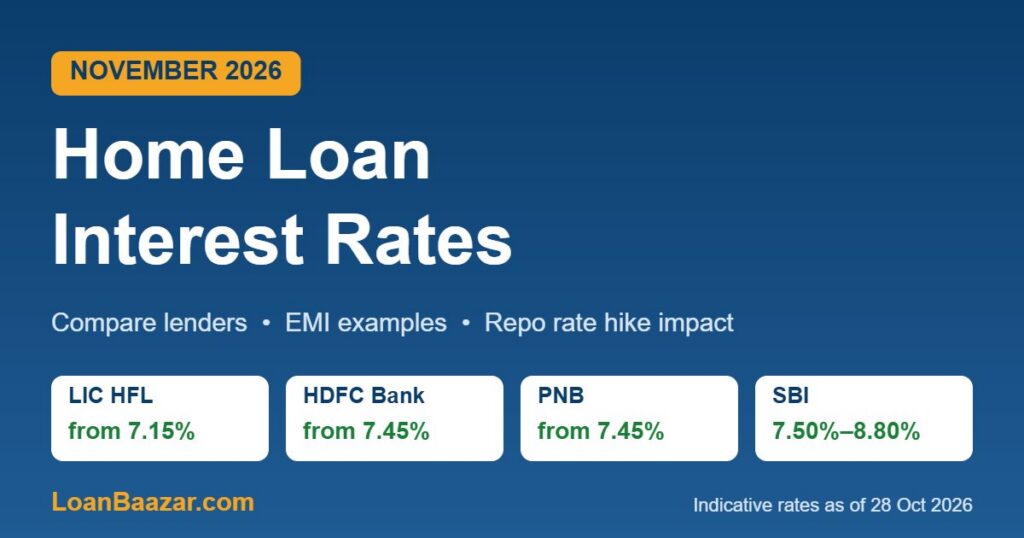
Planning to buy a house? The home loan interest rate you lock in today decides your EMI for the next 15–30 years. Home loan interest rates in India start at around 7.15%–7.50% p.a. in November 2026, but they are rising: after the RBI hiked the repo rate to 5.50% on 7 October 2026, SBI raised its home loan rates by 25 basis points from 15 October, and other lenders are expected to follow.
Last updated: 28 October 2026
Key Highlights
- SBI regular home loans now cost 7.50%–8.80% p.a. (revised from 15 October 2026).
- Other lenders list starting rates from about 7.15% (LIC Housing Finance) to 7.70% (ICICI Bank).
- RBI repo rate: 5.50% after a 25 bps hike on 7 October 2026; most bank home loans are linked to it.
- A 0.25% rise adds about ₹781 a month to the EMI on a ₹50 lakh, 20-year loan.
- Existing borrowers can cut costs through a rate conversion or a balance transfer.
Table of Contents
- Home loan interest rates November 2026: lender comparison
- How the RBI repo rate hike affects home loan rates
- Home loan EMI at different interest rates
- What decides your home loan interest rate
- Existing borrowers: conversion vs balance transfer
- How to get the lowest home loan interest rate
- FAQs
Home Loan Interest Rates November 2026: Lender Comparison
The table compares starting home loan interest rates of major banks and housing finance companies (HFCs). Only borrowers with high credit scores and stable incomes get the starting rate.
| Lender | Home loan interest rate (p.a.) | Type |
|---|---|---|
| LIC Housing Finance | 7.15% onwards | HFC |
| Canara Bank | 7.40% onwards | Public sector bank |
| HDFC Bank | 7.45% onwards | Private bank |
| Punjab National Bank (PNB) | 7.45% onwards | Public sector bank |
| Bajaj Housing Finance | 7.45% onwards | HFC |
| State Bank of India (SBI) | 7.50% – 8.80% | Public sector bank |
| ICICI Bank | 7.70% onwards | Private bank |
Because lenders are repricing after the October hike, check each lender’s website or ask for a written sanction offer before deciding.
How the RBI Repo Rate Hike Affects Home Loan Interest Rates
On 7 October 2026 the RBI raised the repo rate by 25 basis points to 5.50% and moved to a “calibrated tightening” stance, citing rising inflation. Most floating-rate bank home loans are linked to an external benchmark such as the repo rate (EBLR or RLLR), so the hike passes through to borrowers.
- Bank home loans (EBLR-linked): SBI raised its EBLR from 7.90% to 8.15% from 15 October 2026. Existing floating-rate EMIs or tenures rise when your loan resets.
- HFC home loans: HFCs price loans off their own prime lending rate, so changes may reach borrowers more slowly.
- New borrowers: expect higher offers than in the first half of 2026. The next RBI policy meeting is on 2–4 December 2026.
Official policy statements are published on the RBI website.
Home Loan EMI at Different Interest Rates
Even a small change in the home loan interest rate changes your EMI and total interest sharply over 20 years:
| Interest rate | EMI on ₹30 lakh (20 yrs) | EMI on ₹50 lakh (20 yrs) | Total interest on ₹50 lakh |
|---|---|---|---|
| 7.50% | ₹24,168 | ₹40,280 | ₹46,67,118 |
| 8.00% | ₹25,093 | ₹41,822 | ₹50,37,281 |
| 8.50% | ₹26,035 | ₹43,391 | ₹54,13,879 |
| 9.00% | ₹26,992 | ₹44,986 | ₹57,96,711 |
| 9.50% | ₹27,964 | ₹46,607 | ₹61,85,574 |
On a ₹50 lakh loan, 8.5% instead of 7.5% costs about ₹7.5 lakh more in interest over 20 years. Work out your own figures with the home loan EMI calculator.
What Decides Your Home Loan Interest Rate?
- Credit score: Lenders often price home loans by CIBIL band; 750+ usually gets the best rate. See what affects your CIBIL score.
- Loan-to-value (LTV): A bigger down payment lowers the lender’s risk and can lower your rate.
- Income and job stability: Salaried applicants with established employers often get lower spreads than self-employed applicants.
- Loan amount and property: Rates can differ by loan slab and by the property’s type and location.
- Women borrowers: some lenders offer a small concession for women applicants or co-owners.
Existing Borrowers: Rate Conversion vs Balance Transfer
If your rate is well above what new customers are offered, you have two options:
| Conversion with your bank | Balance transfer to a new lender | |
|---|---|---|
| What happens | Spread reset to the new-customer rate | New lender pays off your loan |
| Typical cost | About 0.25%–0.50% of the outstanding loan + GST (some banks cap it, e.g. HDFC at ₹5,000) | Processing fee, legal and valuation charges, stamp duty |
| Time and paperwork | Quick: app, website or branch | Longer: fresh application and property documents |
| Best when | The rate gap is small or moderate | The rate gap is large and many years remain |
Tip: after any rate cut or conversion, keep your EMI unchanged so the lower rate shortens your tenure. That saves the most interest.
How to Get the Lowest Home Loan Interest Rate
- Check your credit report and fix errors before applying.
- Make a larger down payment to reduce LTV.
- Add an earning co-applicant to raise eligibility.
- Compare banks and HFCs on the total cost: rate, processing fee, legal and valuation charges.
- Ask for a written sanction letter and negotiate using competing offers.
- Check your home loan eligibility before you apply to avoid multiple rejections.
Planning your taxes too? Home loans carry deductions on principal and interest; read new vs old tax regime for homebuyers.
Home Loan Interest Rate FAQs
Which bank has the lowest home loan interest rate in November 2026?
Listed starting rates are lowest at LIC Housing Finance (7.15%), Canara Bank (7.40%) and HDFC Bank, PNB and Bajaj Housing Finance (7.45%) as of 28 October 2026. SBI’s revised range is 7.50%–8.80%. Lenders are repricing after the repo hike, so confirm with the lender.
What is the SBI home loan interest rate now?
From 15 October 2026, SBI regular home loans are priced at 7.50%–8.80% p.a., after SBI raised its EBLR by 25 bps to 8.15%.
Will my home loan EMI increase after the RBI repo rate hike?
If your loan is floating-rate and linked to the repo rate, your rate rises at the next reset, increasing your EMI or tenure. A 0.25% increase adds about ₹781 a month on a ₹50 lakh, 20-year loan. Fixed-rate loans are not affected.
Is a fixed or floating home loan interest rate better?
Most Indian home loans are floating. Floating rates fall when the RBI cuts rates and rise when it hikes. Fixed rates give certainty but are usually higher and may reset after a few years. Choose based on how long you will hold the loan and your comfort with EMI changes.
What credit score is needed for the best home loan interest rate?
Most lenders give their lowest rates to borrowers with a CIBIL score of 750 or above; lower scores usually mean a higher rate.
Can I reduce the interest rate on my existing home loan?
Yes. Ask your bank for a rate conversion (usually a fee of about 0.25%–0.50% plus GST) or move your loan through a balance transfer if another lender offers a much lower rate.
Conclusion
Home loan interest rates have started rising after the October 2026 repo rate hike, so comparing lenders and acting on a good offer matters more now. Explore home loan options on LoanBaazar or apply online to compare offers.
Disclaimer: LoanBaazar is a loan marketplace. Interest rates, fees and approval are decided by the lender based on its policies and your profile. Rates are indicative as of the dates stated; please verify the latest terms with the lender before applying.
Related post