LoanBaazar helps you explore loan and credit options from banks and NBFCs. Compare eligibility, fees and repayment terms before applying. Approval and pricing are determined by the lender.
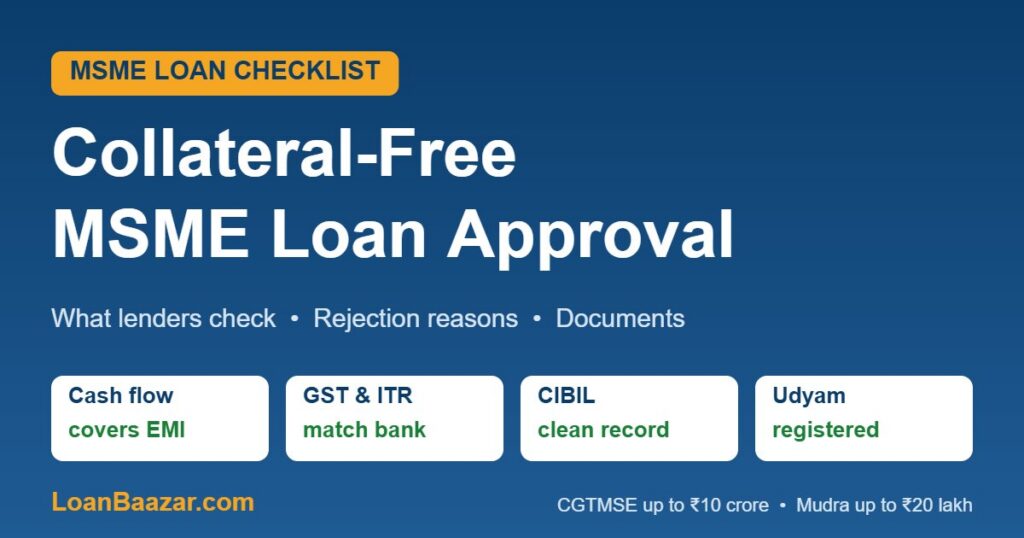
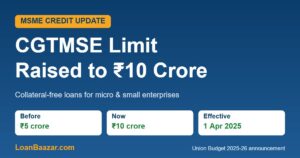
Getting a collateral-free MSME loan is easier than ever: CGTMSE now guarantees loans up to ₹10 crore and Mudra up to ₹20 lakh, so lenders don’t need your property as security. But “no collateral” does not mean “no checks”. Without security, banks and NBFCs look even more closely at your cash flows, records and credit history. This guide explains exactly what lenders check, the most common reasons applications are rejected, and a step-by-step checklist to get your collateral-free MSME loan approved.
Last updated: 3 November 2026
Key Highlights
- Lenders approve a collateral-free MSME loan on cash flow, records and credit history, not assets.
- Udyam registration is the starting point for CGTMSE and most government-backed MSME loans.
- Regular GST filings and business bank statements are the strongest proof of turnover.
- Both the promoter’s CIBIL score and the business’s credit rank (CIBIL MSME Rank) can be checked.
- Most rejections come from weak documentation, high existing debt or cash flows that don’t cover the EMI.
Table of Contents
- What lenders check for a collateral-free MSME loan
- Top reasons collateral-free MSME loans get rejected
- Document checklist
- How to improve your approval chances
- Which collateral-free route fits your business
- Step-by-step application process
- FAQs
What Lenders Check for a Collateral-Free MSME Loan
Because there is no property to fall back on, the lender’s decision rests on whether your business can repay from its own earnings. These are the main areas of assessment:
| What lenders assess | What they look at | What a strong application shows |
|---|---|---|
| Repayment capacity | Monthly cash flows, profit, existing EMIs | Business income comfortably covers all EMIs, including the new one |
| Turnover proof | GST returns, ITRs, bank credits | GST and bank turnover match and are filed regularly |
| Banking behaviour | 12 months of current-account statements | Steady credits, few bounced cheques, no frequent overdrawn balance |
| Credit history | Promoter’s CIBIL score, business credit report | Timely repayments, low credit card use, no defaults or settlements |
| Business stability | Vintage, registration, sector | Udyam and GST registered, operating track record |
| Purpose of loan | Project report or use-of-funds plan | Clear plan showing how the loan grows revenue |
Promoter credit score and business credit rank
For small businesses, lenders usually check the owner’s personal CIBIL score. For businesses with existing business loans, they may also check the company’s credit report, including TransUnion CIBIL’s CIBIL MSME Rank (CMR), which ranks businesses from 1 (lowest risk) to 10 (highest risk). Keep both clean.
Top Reasons Collateral-Free MSME Loans Get Rejected
| Rejection reason | How to fix it |
|---|---|
| Cash flow too weak to cover the EMI | Ask for a smaller amount or longer tenure; reduce other debt first |
| Turnover in GST or ITR doesn’t match bank credits | Route sales through the business account and file returns on time |
| Low promoter CIBIL score or past settlements | Clear overdues and build 6–12 months of on-time repayments before applying |
| Frequent cheque bounces or overdrawn account | Maintain a buffer balance; avoid EMI and cheque returns |
| Incomplete or inconsistent documents | Use the checklist below; keep names and addresses consistent across documents |
| Too many recent loan applications | Apply to one or two well-matched lenders instead of many at once |
| Ineligible activity or no Udyam registration | Check the scheme’s eligible activities; register on the Udyam portal (free) |
Collateral-Free MSME Loan Document Checklist
- KYC: PAN and Aadhaar of promoters; business PAN for firms and companies.
- Registration: Udyam certificate, GST registration, partnership deed or certificate of incorporation as applicable.
- Financials: ITRs with computation, profit & loss account and balance sheet (usually last 2 years for existing businesses).
- GST returns: latest 12 months, where applicable.
- Bank statements: last 12 months of all business current accounts.
- Existing loans: sanction letters and repayment schedules.
- Project report: for new units and larger loans, showing costs, projections and repayment plan.
- Business address proof: rent agreement or ownership document, utility bill.
Exact requirements vary by lender and loan size. A clear project report helps most: see how to make a project report for bank loans.
How to Improve Your Chances of Collateral-Free MSME Loan Approval
- Get your Udyam and GST in order before you apply.
- Run all sales through the business bank account so lenders can see real turnover.
- File GST and income tax returns on time, without large gaps or revisions.
- Keep your CIBIL score strong: pay EMIs and credit card dues on time and avoid settlements.
- Borrow what your cash flow can support; a realistic amount is approved faster.
- Show the purpose clearly: quotations for machinery, a working capital calculation or an order book.
- Choose the right scheme for your size (see below).
- Apply to one or two well-matched lenders and compare sanction terms.
Which Collateral-Free MSME Loan Route Fits Your Business?
| Your situation | Best-fit route |
|---|---|
| Micro business needing up to ₹20 lakh | PM Mudra Yojana (Shishu, Kishor, Tarun, Tarun Plus) |
| Micro or small enterprise needing up to ₹10 crore | Bank or NBFC loan with CGTMSE cover |
| New manufacturing or service unit | PMEGP (bank loan with government subsidy) |
| SC/ST or woman entrepreneur starting a new unit | Stand-Up India (₹10 lakh to ₹1 crore) |
| Need funds within days, strong turnover | Unsecured business loan from a bank or NBFC (usually higher interest) |
Read more: PM Mudra Yojana, PMEGP and our complete MSME loans guide.
Step-by-Step Application Process
- Register on the Udyam portal and keep GST compliant.
- Work out the amount you need and the EMI your cash flow can carry.
- Collect documents using the checklist above and prepare a project report.
- Apply to a bank or NBFC, asking for CGTMSE or the relevant scheme cover; for government-linked schemes you can also apply on the JanSamarth portal.
- Respond quickly to the lender’s queries and site visit.
- Compare sanction letters on interest rate, processing fee, guarantee fee and prepayment terms before accepting.
Collateral-Free MSME Loan FAQs
What is a collateral-free MSME loan?
It is a business loan to a micro, small or medium enterprise that does not require property, gold or other assets as security. Lenders rely on the business’s cash flows and, often, a government credit guarantee such as CGTMSE or the Mudra guarantee fund.
How much can I get as a collateral-free MSME loan?
Up to ₹20 lakh under Mudra and up to ₹10 crore for eligible micro and small enterprises with CGTMSE cover. The actual amount depends on your cash flows and the lender’s assessment.
What CIBIL score is needed for a collateral-free MSME loan?
There is no single cut-off, but lenders prefer a promoter CIBIL score of 700–750 or above with no recent defaults. Businesses with existing loans may also be judged on their CIBIL MSME Rank.
Can a new business get a collateral-free MSME loan?
Yes. Mudra, PMEGP, Stand-Up India and CGTMSE-backed loans can fund new units, but you will need a convincing project report and clean personal credit history.
Why was my collateral-free MSME loan rejected?
Common reasons are cash flows too weak for the EMI, turnover in GST or ITR not matching bank statements, a low credit score, frequent cheque bounces or incomplete documents.
Is Udyam registration mandatory?
For CGTMSE-backed and most government-scheme MSME loans, yes. Registration is free and online on the Udyam portal.
Conclusion
A collateral-free MSME loan is approved on the strength of your records, not your property. Keep GST, ITR and bank statements consistent, protect your credit score, ask for an amount your cash flow supports and choose the right scheme. Ready to apply? Explore business loan options on LoanBaazar or apply online.
Disclaimer: LoanBaazar is a loan marketplace. Scheme limits are as notified by the Government of India; eligibility, interest rates, fees and approval are decided by the lender. Please verify current terms before applying.
Related post